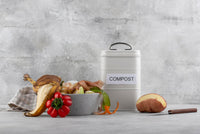
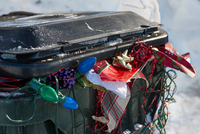
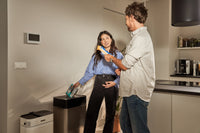
Kitchen compost bin with organic waste

Why Your Kitchen Compost Bin Still Smells and What Actually Fixes It

Alena Hileuskaya
Kitchen compost bin with organic waste
Navigation

"I tried bins with filters before. They still had fruit flies and odor — I was already thinking about buying something else."

— Lauren, customer and five-year composter

If that sounds familiar, you're not alone. You bought the bin with the charcoal filter. Maybe even the fancy one with the bamboo lid. But it still smells, and the fruit flies are still hanging around. Now it just sits under the sink, leaving you feeling a tinge of guilt every time you open the cabinet.

The short answer

Yes, kitchen compost bins smell, and it isn't because you're doing something wrong. Food scraps are mostly water, and the moment they sit in a sealed bin they start breaking down without oxygen, which produces the rotten-egg and sour odors you notice. Carbon filters only mask it, and fruit flies follow the same moisture. The lasting fix is removing moisture at the source, not sealing it in tighter.

So, what's the deal? Keep reading to understand what's happening, why this system will never fully work, and how you can actually deal with your organic waste without the odors, fruit flies, and frustration.

Do Compost Bins Smell? Yes, and Here's Why

If you're wondering whether a kitchen compost bin is supposed to smell, the honest answer is that almost all of them do without the right conditions. A compost bin smells because the food scraps inside are wet organic matter, and wet organic matter breaks down fast in a closed container. The root of the problem is really quite simple: it's moisture.

Moisture Is the Problem

Food scraps are wet organic matter, meaning they contain mostly water — even meat and fish. Consider what you're actually putting in the bin:

Food type Water content
Fruits (berries, citrus, melons) 85%–95%
Vegetables (cucumbers, lettuce, tomatoes) 90%–96%
Cooked grains and pasta 60%–70%
Meat and fish scraps 65%–80%

The moment those scraps go into a sealed container, you've created near-perfect conditions for anaerobic decomposition: a warm environment low in airflow. Within hours, bacteria begin breaking down the waste. Some bacterial populations even double every 20 minutes under favorable conditions.

Most of the byproducts of that process are what you're actually smelling:

  • Hydrogen sulfide emits that rotten egg smell.
  • Ammonia gives off a sharp, acrid odor. If you've searched what ammonia smells like, it's that stinging, cleaning-product sharpness at the back of your nose.
  • Volatile fatty acids offer up sour, rancid notes.
  • Methane, while odorless, is also a sign of active anaerobic breakdown.

According to waste composition research, over 50% of household food scraps are highly biodegradable within 24–48 hours, meaning the smell can start to build almost immediately.

The key insight

The sealed container isn't protecting your kitchen from the smell. It's incubating it. This is the same reason why most Americans generate so much food waste that ends up in landfills rather than being composted: The experience of dealing with it at home is genuinely unpleasant.

Food scraps and vegetable peels in a kitchen compost bin

Why Activated Carbon Filters Only Mask the Smell

Activated carbon filters are the industry's standard answer. They're in nearly every "odor-free" kitchen composter on the market, and they do work — for a while. Carbon traps airborne odor molecules, which reduces smell in the short term. But it doesn't stop decomposition, control moisture, or prevent fruit flies. And once the filter saturates — usually within a few weeks — it stops working entirely.

Here's what actually happens once you close the lid:

  • Food waste releases odor compounds as bacteria multiply.
  • The filter absorbs some of them, temporarily.
  • Moisture continues accumulating inside the bin.
  • Bacterial activity intensifies with no change in conditions.
  • Odor production outpaces what the filter can handle.
  • The bin smells again, now with a saturated filter that needs replacing.
  • You replace the filter and restart the cycle.

Lauren experienced this directly. She tried multiple lidded bins with carbon filters before discovering Clear Drop's Organics Collector (OC). The filters didn't stop the fruit flies or prevent the smell from returning. They just delayed them.

Why Your Compost Bin Smells and Has Flies

If your compost bin both smells and has fruit flies, the two problems share one cause: moist, fermenting food waste. The odor is the chemistry of decomposition, and the flies are biology responding to that same material. Fix the moisture and you address both at once. Fruit flies aren't your fault! Here's what makes them so persistent:

  • They can detect fermenting organic material from several meters away.
  • They lay eggs directly on moist food waste.
  • Eggs hatch within 24–30 hours.
  • A single female can lay up to 500 eggs over her lifetime.
  • Residual moisture and micro-particles in a "clean" bin are enough to restart the cycle.

By the time you notice one fruit fly near your bin, the cycle is already underway. Cleaning the bin breaks the current generation, but as long as there's warm, moist organic material inside, new flies will arrive within days.

kitchen waste bin vegetables leftovers
Worth knowing

No anti-odor filter can stop this. Fruit flies are responding to the biological activity happening inside the container, which exists because moisture does. This is the same biological dynamic that drives larger food waste and composting challenges at every scale.

How to Keep a Compost Bin From Smelling: Common Mistakes

Most people troubleshoot their compost bin by doing more of what already isn't working. If you've been trying to keep your compost bin from smelling and nothing sticks, it's likely one of these. Here's what typically backfires and why:

What people try Why it doesn't work
Sealing the lid more tightly Creates more anaerobic conditions, intensifying bacterial activity
Adding dry materials (cardboard, paper) Rarely offsets the daily moisture input from fresh scraps
Emptying more frequently Odor forms within hours — faster than most emptying schedules
Using compostable bags Traps moisture against the waste, accelerating decomposition
Storing the bin under the sink Sits in the warmest, least-ventilated spot — ideal for bacteria and flies
Rinsing with baking soda Neutralizes existing odor briefly; doesn't prevent new formation

Lauren eventually moved her OC to the laundry room near the back door. Not because the device required it, but because it made her existing composting habit more natural.

What Actually Works: Removing Moisture at the Source

If moisture drives bacterial growth, and bacterial growth produces odor, the solution is clear: Reduce moisture before decomposition accelerates.

This is standard practice in industrial organic waste processing. Large-scale systems routinely reduce moisture content by 50%–70% before further handling — and the effect is dramatic. Research shows that reducing moisture from the over 90% found in fresh scraps to industrial targets of 50%–60% can greatly lower bacterial activity and odor production. Less moisture means slower microbial activity, which means significantly less odor.

90%+

water content in fresh food scraps — the primary driver of odor and bacterial growth

50–70%

moisture reduction achieved by industrial organic waste systems before further handling

24–48h

how quickly over 50% of household food scraps begin to biodegrade — and smell

500

eggs a single fruit fly can lay over her lifetime — triggered by moist organic material

In a home setting, typical kitchen compost bins don't address moisture at all. They hold whatever you put in them and wait. This is true whether you're using a basic countertop bin or a more advanced indoor compost machine. If the design doesn't actively manage moisture, the odor problem remains.

This gap between what industrial systems do and what home products offer is part of what Clear Drop is working to close — by applying the logic of professional waste management to everyday household use and making valuable technology to reduce food waste in the kitchen.

How the Organics Collector Solves This Differently

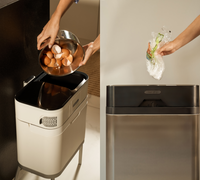
Clear Drop Organics Collector food scrap bin

The Organics Collector (OC) is neither a compost bin nor a standard electric composter. It's a collection system designed around what actually causes the main frustrations with composting.

Here's how it compares to what most people have tried:

Feature Standard bin + filter Electric composter Organics Collector
Addresses moisture Partially
Prevents odor at source
Controls fruit flies
Requires filter replacement Regular Sometimes
Needs daily emptying Often No No
Works in summer heat Poorly Variable
Works without bags Yes Yes Yes

Rather than sealing moisture inside and hoping a filter catches the odor in time, the OC actively reduces moisture content and limits the conditions that allow bacterial activity to take hold. The result:

  • No sludge or sticky residue building up inside
  • No sulfur or ammonia smell when you open the lid
  • No fruit fly infestations restarting every week
  • No filter replacements when carbon saturates
  • No daily emptying just to keep things manageable
"The fan and filter system actually works. None of the others did." — Lauren, OC customer and five-year composter

She uses no compostable bags, washes the device directly after emptying, and reports no issues with odor or pests. For a household that has composted for over five years and takes waste reduction seriously, that's a meaningful shift.

Most kitchen composter improvements tend to be incremental, like using better seals or thicker filters. The OC addresses a different question entirely: What if you can manage organic waste without creating an odorous environment to begin with?


If you're also managing soft plastic waste in your kitchen, the Soft Plastic Compactor works alongside the OC. Together, they cover the two waste streams that most households struggle to manage. Learn more about how Clear Drop's full approach to home waste works here.

Ready to fix the real problem?

The Organics Collector addresses moisture at the source — no more odors, no more fruit flies, no more frustration.

Shop the Organics Collector →

Latest posts All posts

No Backyard? Here's Where Your Food Scraps Can Actually Go

No Backyard? Here's Where Your Food Scraps Can Actually Go

Throughout the day, you collect vegetable peels, coffee grounds, eggshells, and other food sc...
Can You Compost Bread? (And What to Do With Stale Baked Goods)

Can You Compost Bread? (And What to Do With Stale Baked Goods)

  You've found a loaf that's gone stale, a few pizza crusts left after dinner, or crackers tha...
Are Ziploc Bags Recyclable? The Honest Answer About Soft Plastics at Home

Are Ziploc Bags Recyclable? The Honest Answer About Soft Plastics at Home

  Many people assume Ziploc bags go in the recycling bin along with bottles, cans, and cardboa...
Can You Compost Cooked Food? What Goes In (And What Doesn't)

Can You Compost Cooked Food? What Goes In (And What Doesn't)

  You're already full but looking down at a half-eaten plate. You pause. The compost bin is ri...
6 Steps to Launching a ZeroTrash Program at Your Organization

6 Steps to Launching a ZeroTrash Program at Your Organization

Sustainability intentions are easy. Operational sustainability is harder — and far more val...
The Real Difference Between Composting and Organic Waste Collection

The Real Difference Between Composting and Organic Waste Collection

Most people trying to manage food waste hit the same wall. Backyard composting requires outdoor...
Organic Waste Laws by State: What's Already Required and What's Coming

Organic Waste Laws by State: What's Already Required and What's Coming

Most conversations about composting start with legitimate questions: Why does it matter? What d...
How To Talk to Your Roommates (or Partner) About Waste Sorting

How To Talk to Your Roommates (or Partner) About Waste Sorting

You've already done the hard work: figured out how to sort your food scraps, learned that soft ...
Food Scraps in the Landfill: What's Actually Happening Underground

Food Scraps in the Landfill: What's Actually Happening Underground

Most food scraps end up in landfills, where they produce methane — a greenhouse gas far more po...
Atlantic Health Demonstrates Diversion of One Ton of Plastic Waste Annually with SPC

Atlantic Health Demonstrates Diversion of One Ton of Plastic Waste Annually with SPC

Single-use plastic waste is one of the most persistent challenges facing healthcare facilities ...
Earth Day 2026: 5 Waste Habits That Make a Real Difference at Home

Earth Day 2026: 5 Waste Habits That Make a Real Difference at Home

🌍 Earth Day 2026 5 Small Habits That Actually Reduce Household Wast...
The Organics Collector as a Community Tool: Why Early Adopters Are Leading the Change

The Organics Collector as a Community Tool: Why Early Adopters Are Leading the Change

Most people assume that waste habits are shaped by systems — city programs, building rules, mun...
How Sustainable Practices Help Attract and Retain Business Customers

How Sustainable Practices Help Attract and Retain Business Customers

"Our clients' clients are holding them accountable for sustainability, and that pressure trave...
Why Your Kitchen Compost Bin Still Smells and What Actually Fixes It

Why Your Kitchen Compost Bin Still Smells and What Actually Fixes It

"I tried bins with filters before. They still had fruit flies and odor — I was already thinki...
What is an Organics Collector? (And Why It’s Not a Composter)

What is an Organics Collector? (And Why It’s Not a Composter)

What Is an Organics Collector? (And Why It's Not a Composter) A quick search for a "composter a...
Global Recycling Day: The Reality of  Recycling and How You Can Help Improve the Stats

Global Recycling Day: The Reality of Recycling and How You Can Help Improve the Stats

March 18 is Global Recycling Day, an international initiative created by the Global Recycling F...
Soft Plastic Recycling Myths That Stop People from Taking Action

Soft Plastic Recycling Myths That Stop People from Taking Action

Soft plastic recycling myths that stop people from taking action Soft plastic recycling can be ...
How ZeroTrash Initiatives Improve Workplace Culture and Attract Eco-Conscious Talent

How ZeroTrash Initiatives Improve Workplace Culture and Attract Eco-Conscious Talent

Plus, A 6-Step Approach to Implementing ZeroTrash Adoption Sustainability is no longer a side ini...
Mandatory Organic Waste Separation in New York: How To Comply Without Odors, Messes, or Fines

Mandatory Organic Waste Separation in New York: How To Comply Without Odors, Messes, or Fines

Over the past couple of years, New York City has steadily changed how residential waste is ...
UCSF Health's Mission Bay Hospital Achieves Guaranteed Recycling of Pharmacy Soft Plastic Waste with Clear Drop SPC

UCSF Health's Mission Bay Hospital Achieves Guaranteed Recycling of Pharmacy Soft Plastic Waste with Clear Drop SPC

Healthcare facilities generate massive amounts of plastic waste daily, and California's ambitiou...
How To Compost Eggshells and Vegetable Scraps the Right Way: Faster, Nutrient-Rich Composting & Zero-Waste Kitchen Tips

How To Compost Eggshells and Vegetable Scraps the Right Way: Faster, Nutrient-Rich Composting & Zero-Waste Kitchen Tips

In many homes, food scraps make up around 25% to 30% of household waste. When sent to landfills, ...
Soft Plastic Compactor vs. Curbside Recycling: The Real Difference

Soft Plastic Compactor vs. Curbside Recycling: The Real Difference

Most people assume recycling works when something goes into the blue bin. But for soft...
How Your Household Can Save Up to $240 a Year on Trash Costs

How Your Household Can Save Up to $240 a Year on Trash Costs

Household trash bills are rarely questioned. Most people accept them as a fixed cost, just like...
How ZeroTrash® AI Helps You Identify Soft Plastics Correctly

How ZeroTrash® AI Helps You Identify Soft Plastics Correctly

ZeroTrash® AI is designed to take the guesswork out of everyday waste decisions. Using a camer...
Why CES 2026 Shifted the Conversation Around Household Waste

Why CES 2026 Shifted the Conversation Around Household Waste

CES has always been a place for bold ideas and ambitious visions. But this year, we noticed a sub...
How to Compost in an Apartment (Without Annoying Your Neighbors or Your Landlord)

How to Compost in an Apartment (Without Annoying Your Neighbors or Your Landlord)

Many people still believe composting requires a yard. In reality, modern indoor composting work...
Post-Holiday Waste Reset: Starting 2026 With a Clean, ZeroTrash® Kitchen

Post-Holiday Waste Reset: Starting 2026 With a Clean, ZeroTrash® Kitchen

The holidays may bring plenty of celebration — but they can also leave a big mess, between a clut...
From Trash to Treasure: Real Products Made From Recycled Soft Plastics (and How Clear Drop Makes It Happen)

From Trash to Treasure: Real Products Made From Recycled Soft Plastics (and How Clear Drop Makes It Happen)

Fun fact: Soft plastics aren’t “unrecyclable.” They’ve just been collected the wrong way for over...
Holiday Composting Guide 2025: How to Reduce Waste at Christmas & New Year Events

Holiday Composting Guide 2025: How to Reduce Waste at Christmas & New Year Events

The holidays bring plenty of food, cheer, and …. waste? With all those extra food scraps, packagi...
How Much Food Americans Waste and What You Can Do

How Much Food Americans Waste and What You Can Do

Key Takeaways Americans waste 30%-40% of their total food supply each year ...
How the Shaw Institute Successfully Started to Recycle Laboratory Soft Plastic Waste for the First Time with SPC

How the Shaw Institute Successfully Started to Recycle Laboratory Soft Plastic Waste for the First Time with SPC

The Shaw Institute in Blue Hill, Maine, is a respected nonprofit research organization studying t...
10 Soft Plastics You Didn’t Know You Could Recycle at Home

10 Soft Plastics You Didn’t Know You Could Recycle at Home

Key Takeaways Only 1% of U.S. households have access to curbside film recyc...
How Clear Drop’s Soft Plastic Compactor (SPC) Recycling System Works | Clear Drop

How Clear Drop’s Soft Plastic Compactor (SPC) Recycling System Works | Clear Drop

At Clear Drop, we're redefining what responsible soft plastic recycling looks like. Our Sof...
How Geekdom sparked early wins in soft plastic recovery with the Clear Drop's SPC

How Geekdom sparked early wins in soft plastic recovery with the Clear Drop's SPC

Geekdom is a cornerstone of San Antonio’s startup and innovation ecosystem. Spread across four fl...
How Trinity University advanced soft plastic recycling with the SPC

How Trinity University advanced soft plastic recycling with the SPC

Flexible plastic waste is one of the most persistent challenges on college campuses. From snack w...
From soft plastic to microplastic: what to know

From soft plastic to microplastic: what to know

Soft plastic packaging surrounds almost every product we buy — bags, wrappers, film, shippi...
Survey reveals trash sparks more fights than childcare, and why recycling Is at the heart of It

Survey reveals trash sparks more fights than childcare, and why recycling Is at the heart of It

Trash duties are the most underestimated part of modern household life—yet they’re one of the big...
How one office building pilot became a model for smarter soft plastic waste reduction

How one office building pilot became a model for smarter soft plastic waste reduction

Commercial buildings generate a large share of soft plastic waste — from deliveries, shipments, ...
Official rules: Clear Drop OC pre-order giveaway

Official rules: Clear Drop OC pre-order giveaway

The drawing was heldWINNER SELECTION VIDEO1. SPONSOR The Clear Drop Pre-Order Giveaway (the “Give...
Fixing the broken recycling system: why Clear Drop® exists

Fixing the broken recycling system: why Clear Drop® exists

The global recycling system is struggling to keep up with the waste we generate. Most soft pla...
Getting started with soft plastic waste collection at home

Getting started with soft plastic waste collection at home

Flexible packaging makes everyday life easier, but most soft plastics still end up in landf...
How Eduardo's Bridal & Tuxedo reduced soft plastic waste volume by 90% with the SPC

How Eduardo's Bridal & Tuxedo reduced soft plastic waste volume by 90% with the SPC

Garment retail businesses rely heavily on flexible plastic packaging to protect inventory. But on...
Clear Drop: how we’re revolutionizing home waste management

Clear Drop: how we’re revolutionizing home waste management

Most household waste still ends up in landfills, not because people do not want to recycle, but b...
Why business recycling matters: a key to corporate sustainability

Why business recycling matters: a key to corporate sustainability

Corporate sustainability is now a critical business priority. Both employees and customers ...
Tackling plastic in the healthcare industry: challenges and solutions

Tackling plastic in the healthcare industry: challenges and solutions

U.S. healthcare produces more than 5 million tons of waste every year, and plastics account for...
Composting: electric vs. professional or traditional options

Composting: electric vs. professional or traditional options

In the United States, food scraps make up a significant share of household waste — yet only...
Soft plastic recycling: key challenges and solutions

Soft plastic recycling: key challenges and solutions

Soft plastics like grocery bags, bubble wrap, and packaging film make up a growing share of...
All posts

FAQs

Yes. Almost every kitchen compost bin develops an odor because food scraps are mostly water, and that moisture fuels anaerobic bacteria within hours of the lid closing. The bacteria release hydrogen sulfide (rotten egg), ammonia, and sour volatile fatty acids. A bin only stays odor-free if it actively manages moisture rather than just sealing the waste in.

The only lasting way is to reduce moisture before decomposition speeds up. Tightening the lid, adding paper, or emptying more often gives short-term relief at best, because odor forms within hours and sealed bins make anaerobic breakdown worse. A system that lowers moisture content keeps bacterial activity, and therefore smell, from building in the first place.

Emptying schedules don't reliably solve odor because food scraps start to smell within 24 to 48 hours, faster than most people empty. Daily emptying helps a little but isn't practical long term. Controlling moisture matters far more than frequency: a bin that keeps scraps dry can hold about a week of waste without the smell that a standard bin develops in a day or two.

Both come from the same source: warm, moist, fermenting food waste. The odor is the chemistry of decomposition, and the flies are attracted to that exact material, laying eggs that hatch in 24 to 30 hours. Cleaning kills the current generation but new flies return within days unless the moist organic material is dried out or removed.

Activated carbon traps odor molecules in the air, so it helps briefly, but it does nothing about moisture, decomposition, or fruit flies. Filters also saturate within a few weeks and then stop working entirely. The smell returns because the cause, moist food waste breaking down without oxygen, is still inside the bin.

That sharp, stinging odor is ammonia released as nitrogen-rich scraps break down without enough oxygen. It's a sign of active anaerobic decomposition inside the bin, often alongside the rotten-egg smell of hydrogen sulfide. Both signal too much moisture and too little airflow.