Food scraps on the kitchen

No Backyard? Here's Where Your Food Scraps Can Actually Go

Alena Hileuskaya
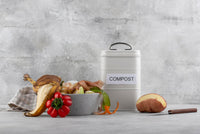
Food scraps on the kitchen
Navigation

Throughout the day, you collect vegetable peels, coffee grounds, eggshells, and other food scraps. You know throwing them in the trash isn't ideal, and you know composting is supposed to be the answer. But what if you don't have a backyard?

Quick Answer

You have four realistic options: municipal organics pickup, community drop-off programs, electric composters, or an indoor organic waste collector. For most apartment dwellers, indoor collection is the most accessible starting point because it requires no outdoor space or special equipment and works anywhere.

According to the U.S. Census Bureau, roughly one-third of American households live in multi-unit housing. For most of those residents, traditional composting is simply not practical. (Source: U.S. Census Bureau Housing Data)

The good news is that outdoor composting is not the only option. Here are the alternatives and how they compare.

Why "Just Compost It" Doesn't Work for Everyone

Most composting guides assume you have outdoor space. They recommend building a compost pile, using a backyard tumbler, managing layers of greens and browns, turning compost regularly, and monitoring moisture and airflow.

For homeowners with gardens, those steps may be realistic. For apartment residents, they often are not.

Even people who genuinely want to reduce food waste run into consistent barriers, such as:

  • No outdoor space or garden
  • Building restrictions on outdoor equipment
  • Pest concerns in shared spaces
  • Odors in small indoor areas
  • Lack of local compost infrastructure
  • Limited kitchen storage

So what are the alternatives?

Green organics collection bins on a city curb

Option 1: Municipal Organics Pickup

Some cities now offer organics collection programs that let residents place food scraps in dedicated bins. Collected materials go to industrial composting facilities that process food waste at scale under controlled conditions.

Who Has It, Who Doesn't

Municipal organics programs are expanding, but availability varies significantly. Some cities offer weekly food waste pickup with separate bins and accepted food scrap lists. Others provide no organic waste collection at all. Even within the same state, neighboring communities may have completely different services.

New York City, for example, has implemented mandatory organic waste separation for residential buildings. If you're in NYC, see how to comply without odors or fines.

If you're not sure what's available in your city, check your local waste management provider's website or municipal sustainability program.

Municipal Pickup Pros Cons
What to expect Convenient when available; handles a wide variety of food waste; no special equipment required Not available in most U.S. cities; rules vary and can be confusing; scraps still need clean storage between pickups

Option 2: Community Drop-Off Programs

Some communities offer compost drop-off sites where residents bring food scraps. These programs are common at farmers markets, community gardens, sustainability centers, and municipal recycling facilities.

Instead of curbside pickup, you collect food scraps at home and transport them to a designated location.

Drop-Off Programs Pros Cons
What to expect Available in some areas without curbside collection; supports local composting infrastructure; accepts many types of food scraps Requires a dedicated trip; participation drops off quickly due to inconvenience; scraps still need home storage between trips

For many households, the biggest challenge with drop-off programs is making the trip consistently, especially in winter or during busy weeks.

Option 3: Electric Composters

Electric composters have recently gained attention as a practical indoor food waste solution. These countertop appliances use heat, grinding, and dehydration to reduce food waste volume.

While often marketed as composters, most units do not produce finished compost. They create dried or ground material that still requires further composting or disposal. The New York Times noted that output from many countertop food recyclers may actually attract pests or harm plants if used directly as fertilizer.

Electric Composters Pros Cons
What to expect Works indoors; reduces food waste volume quickly; no outdoor space needed High upfront cost, often $300 to $500+; energy-intensive cycles; output is not finished compost and may still need composting or disposal; noise during operation
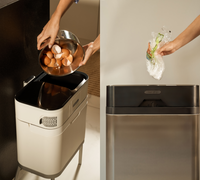
Person separating food scraps in a kitchen

Option 4: Indoor Organic Waste Collection

For many apartment dwellers, the most practical solution is straightforward: collect food scraps properly in a contained indoor system, then take them to whatever composting or organics program is available.

Rather than focusing immediately on processing food waste, this approach focuses on consistent, clean separation at the source.

What Makes This the Lowest-Friction Option

Behavioral research consistently shows that convenience drives participation. The easier a sustainability habit becomes, the more likely households are to maintain it.

Indoor organic waste collection doesn't require a backyard, outdoor equipment, or complex compost management. Instead, it:

  • Works in any kitchen of any size
  • Fits existing daily routines
  • Prepares scraps for any downstream option, including pickup, drop-off, or outdoor composting

Making the separation of food scraps a consistent habit helps divert organic waste from landfills.

Which Option Is Right for You?

The best solution depends on where you live, your budget, and what services are available.

Option Effort Cost Availability Odor Control
Backyard Composting High Low Outdoor space required Moderate
Municipal Pickup Low Included Limited by location Good
Community Drop-Off Moderate Low Location dependent Good
Electric Composter Low High ($300+) Widely available Good
Indoor OC (Clear Drop) Very Low From $40/mo Available anywhere Excellent

For most apartment residents, indoor collection offers the most convenience. It doesn't require owning property, purchasing expensive equipment, or having access to specialized services.

The OC Approach to Food Scraps Without a Backyard

Clear Drop Organics Collector on a kitchen counter

For households without outdoor space, the biggest challenge with food waste is managing scraps in a way that is clean, practical, and sustainable on a daily basis.

The Clear Drop Organics Collector (OC)

The Clear Drop Organics Collector (OC) was designed specifically for this problem. This smart food scrap bin is built for modern kitchens and urban households, where outdoor composting is not an option and convenience matters.

What sets the OC apart from both open bins and electric composters:

  • Uses air ventilation, ozone, and carbon filtration technology to slow microbial growth and eliminate odors without grinding or heating
  • Reduces moisture by up to 40% daily, keeping scraps dry and contained
  • Includes an automatic sliding lid that opens without touching, a useful feature during food prep and cleaning
  • Holds up to 3.7 gallons, roughly one week of food scraps for a family of four
  • Operates silently and consumes a maximum of 5.1 kWh per month (approximately $0.84 in electricity)
  • Is ETL-certified for safety in North American households
  • Mounts on a wall, sits on a countertop, or stands on included legs

The OC accepts all common kitchen organics, including:

  • Fruit and vegetable scraps
  • Coffee grounds and tea leaves
  • Eggshells
  • Leftover cooked food
  • Bread and baked goods
  • Meat, fish, and seafood
  • Food preparation waste
Note

The OC is not a composting machine. It does not process or break down food waste. It keeps scraps dry, odor-free, and contained for up to a week, then you empty the inner bin into a municipal organics cart, community drop-off site, or outdoor composter. The actual composting happens downstream, where it can be done properly at scale.

The OC is available for a one-time purchase of $399 or $40/month for 12 months, with a 30-day risk-free return policy and 1-year warranty. Free shipping is available throughout the contiguous U.S. Learn more about the OC.

Start Collecting Without the Outdoor Space

You don't need a garden or a compost pile to reduce food waste, and you definitely don't need to be a composting expert.

The most effective solution is often the simplest. For those without outdoor space, creating a convenient system that makes food scrap collection part of your daily routine can be both easy and sustainable. That one change can make a meaningful difference in how much organic waste ends up in the landfill.

Make Food Scrap Collection Effortless

With the Clear Drop OC, food waste collection becomes a habit that fits into your kitchen and your schedule, whether or not your city offers curbside organics pickup.

Explore the Organics Collector →

Latest posts All posts

No Backyard? Here's Where Your Food Scraps Can Actually Go

No Backyard? Here's Where Your Food Scraps Can Actually Go

Throughout the day, you collect vegetable peels, coffee grounds, eggshells, and other food sc...
Can You Compost Bread? (And What to Do With Stale Baked Goods)

Can You Compost Bread? (And What to Do With Stale Baked Goods)

  You've found a loaf that's gone stale, a few pizza crusts left after dinner, or crackers tha...
Are Ziploc Bags Recyclable? The Honest Answer About Soft Plastics at Home

Are Ziploc Bags Recyclable? The Honest Answer About Soft Plastics at Home

  Many people assume Ziploc bags go in the recycling bin along with bottles, cans, and cardboa...
Can You Compost Cooked Food? What Goes In (And What Doesn't)

Can You Compost Cooked Food? What Goes In (And What Doesn't)

  You're already full but looking down at a half-eaten plate. You pause. The compost bin is ri...
6 Steps to Launching a ZeroTrash Program at Your Organization

6 Steps to Launching a ZeroTrash Program at Your Organization

Sustainability intentions are easy. Operational sustainability is harder — and far more val...
The Real Difference Between Composting and Organic Waste Collection

The Real Difference Between Composting and Organic Waste Collection

Most people trying to manage food waste hit the same wall. Backyard composting requires outdoor...
Organic Waste Laws by State: What's Already Required and What's Coming

Organic Waste Laws by State: What's Already Required and What's Coming

Most conversations about composting start with legitimate questions: Why does it matter? What d...
How To Talk to Your Roommates (or Partner) About Waste Sorting

How To Talk to Your Roommates (or Partner) About Waste Sorting

You've already done the hard work: figured out how to sort your food scraps, learned that soft ...
Food Scraps in the Landfill: What's Actually Happening Underground

Food Scraps in the Landfill: What's Actually Happening Underground

Most food scraps end up in landfills, where they produce methane — a greenhouse gas far more po...
Atlantic Health Demonstrates Diversion of One Ton of Plastic Waste Annually with SPC

Atlantic Health Demonstrates Diversion of One Ton of Plastic Waste Annually with SPC

Single-use plastic waste is one of the most persistent challenges facing healthcare facilities ...
Earth Day 2026: 5 Waste Habits That Make a Real Difference at Home

Earth Day 2026: 5 Waste Habits That Make a Real Difference at Home

🌍 Earth Day 2026 5 Small Habits That Actually Reduce Household Wast...
The Organics Collector as a Community Tool: Why Early Adopters Are Leading the Change

The Organics Collector as a Community Tool: Why Early Adopters Are Leading the Change

Most people assume that waste habits are shaped by systems — city programs, building rules, mun...
How Sustainable Practices Help Attract and Retain Business Customers

How Sustainable Practices Help Attract and Retain Business Customers

"Our clients' clients are holding them accountable for sustainability, and that pressure trave...
Why Your Kitchen Compost Bin Still Smells and What Actually Fixes It

Why Your Kitchen Compost Bin Still Smells and What Actually Fixes It

"I tried bins with filters before. They still had fruit flies and odor — I was already thinki...
What is an Organics Collector? (And Why It’s Not a Composter)

What is an Organics Collector? (And Why It’s Not a Composter)

What Is an Organics Collector? (And Why It's Not a Composter) A quick search for a "composter a...
Global Recycling Day: The Reality of  Recycling and How You Can Help Improve the Stats

Global Recycling Day: The Reality of Recycling and How You Can Help Improve the Stats

March 18 is Global Recycling Day, an international initiative created by the Global Recycling F...
Soft Plastic Recycling Myths That Stop People from Taking Action

Soft Plastic Recycling Myths That Stop People from Taking Action

Soft plastic recycling myths that stop people from taking action Soft plastic recycling can be ...
How ZeroTrash Initiatives Improve Workplace Culture and Attract Eco-Conscious Talent

How ZeroTrash Initiatives Improve Workplace Culture and Attract Eco-Conscious Talent

Plus, A 6-Step Approach to Implementing ZeroTrash Adoption Sustainability is no longer a side ini...
Mandatory Organic Waste Separation in New York: How To Comply Without Odors, Messes, or Fines

Mandatory Organic Waste Separation in New York: How To Comply Without Odors, Messes, or Fines

Over the past couple of years, New York City has steadily changed how residential waste is ...
UCSF Health's Mission Bay Hospital Achieves Guaranteed Recycling of Pharmacy Soft Plastic Waste with Clear Drop SPC

UCSF Health's Mission Bay Hospital Achieves Guaranteed Recycling of Pharmacy Soft Plastic Waste with Clear Drop SPC

Healthcare facilities generate massive amounts of plastic waste daily, and California's ambitiou...
How To Compost Eggshells and Vegetable Scraps the Right Way: Faster, Nutrient-Rich Composting & Zero-Waste Kitchen Tips

How To Compost Eggshells and Vegetable Scraps the Right Way: Faster, Nutrient-Rich Composting & Zero-Waste Kitchen Tips

In many homes, food scraps make up around 25% to 30% of household waste. When sent to landfills, ...
Soft Plastic Compactor vs. Curbside Recycling: The Real Difference

Soft Plastic Compactor vs. Curbside Recycling: The Real Difference

Most people assume recycling works when something goes into the blue bin. But for soft...
How Your Household Can Save Up to $240 a Year on Trash Costs

How Your Household Can Save Up to $240 a Year on Trash Costs

Household trash bills are rarely questioned. Most people accept them as a fixed cost, just like...
How ZeroTrash® AI Helps You Identify Soft Plastics Correctly

How ZeroTrash® AI Helps You Identify Soft Plastics Correctly

ZeroTrash® AI is designed to take the guesswork out of everyday waste decisions. Using a camer...
Why CES 2026 Shifted the Conversation Around Household Waste

Why CES 2026 Shifted the Conversation Around Household Waste

CES has always been a place for bold ideas and ambitious visions. But this year, we noticed a sub...
How to Compost in an Apartment (Without Annoying Your Neighbors or Your Landlord)

How to Compost in an Apartment (Without Annoying Your Neighbors or Your Landlord)

Many people still believe composting requires a yard. In reality, modern indoor composting work...
Post-Holiday Waste Reset: Starting 2026 With a Clean, ZeroTrash® Kitchen

Post-Holiday Waste Reset: Starting 2026 With a Clean, ZeroTrash® Kitchen

The holidays may bring plenty of celebration — but they can also leave a big mess, between a clut...
From Trash to Treasure: Real Products Made From Recycled Soft Plastics (and How Clear Drop Makes It Happen)

From Trash to Treasure: Real Products Made From Recycled Soft Plastics (and How Clear Drop Makes It Happen)

Fun fact: Soft plastics aren’t “unrecyclable.” They’ve just been collected the wrong way for over...
Holiday Composting Guide 2025: How to Reduce Waste at Christmas & New Year Events

Holiday Composting Guide 2025: How to Reduce Waste at Christmas & New Year Events

The holidays bring plenty of food, cheer, and …. waste? With all those extra food scraps, packagi...
How Much Food Americans Waste and What You Can Do

How Much Food Americans Waste and What You Can Do

Key Takeaways Americans waste 30%-40% of their total food supply each year ...
How the Shaw Institute Successfully Started to Recycle Laboratory Soft Plastic Waste for the First Time with SPC

How the Shaw Institute Successfully Started to Recycle Laboratory Soft Plastic Waste for the First Time with SPC

The Shaw Institute in Blue Hill, Maine, is a respected nonprofit research organization studying t...
10 Soft Plastics You Didn’t Know You Could Recycle at Home

10 Soft Plastics You Didn’t Know You Could Recycle at Home

Key Takeaways Only 1% of U.S. households have access to curbside film recyc...
How Clear Drop’s Soft Plastic Compactor (SPC) Recycling System Works | Clear Drop

How Clear Drop’s Soft Plastic Compactor (SPC) Recycling System Works | Clear Drop

At Clear Drop, we're redefining what responsible soft plastic recycling looks like. Our Sof...
How Geekdom sparked early wins in soft plastic recovery with the Clear Drop's SPC

How Geekdom sparked early wins in soft plastic recovery with the Clear Drop's SPC

Geekdom is a cornerstone of San Antonio’s startup and innovation ecosystem. Spread across four fl...
How Trinity University advanced soft plastic recycling with the SPC

How Trinity University advanced soft plastic recycling with the SPC

Flexible plastic waste is one of the most persistent challenges on college campuses. From snack w...
From soft plastic to microplastic: what to know

From soft plastic to microplastic: what to know

Soft plastic packaging surrounds almost every product we buy — bags, wrappers, film, shippi...
Survey reveals trash sparks more fights than childcare, and why recycling Is at the heart of It

Survey reveals trash sparks more fights than childcare, and why recycling Is at the heart of It

Trash duties are the most underestimated part of modern household life—yet they’re one of the big...
How one office building pilot became a model for smarter soft plastic waste reduction

How one office building pilot became a model for smarter soft plastic waste reduction

Commercial buildings generate a large share of soft plastic waste — from deliveries, shipments, ...
Official rules: Clear Drop OC pre-order giveaway

Official rules: Clear Drop OC pre-order giveaway

The drawing was heldWINNER SELECTION VIDEO1. SPONSOR The Clear Drop Pre-Order Giveaway (the “Give...
Fixing the broken recycling system: why Clear Drop® exists

Fixing the broken recycling system: why Clear Drop® exists

The global recycling system is struggling to keep up with the waste we generate. Most soft pla...
Getting started with soft plastic waste collection at home

Getting started with soft plastic waste collection at home

Flexible packaging makes everyday life easier, but most soft plastics still end up in landf...
How Eduardo's Bridal & Tuxedo reduced soft plastic waste volume by 90% with the SPC

How Eduardo's Bridal & Tuxedo reduced soft plastic waste volume by 90% with the SPC

Garment retail businesses rely heavily on flexible plastic packaging to protect inventory. But on...
Clear Drop: how we’re revolutionizing home waste management

Clear Drop: how we’re revolutionizing home waste management

Most household waste still ends up in landfills, not because people do not want to recycle, but b...
Why business recycling matters: a key to corporate sustainability

Why business recycling matters: a key to corporate sustainability

Corporate sustainability is now a critical business priority. Both employees and customers ...
Tackling plastic in the healthcare industry: challenges and solutions

Tackling plastic in the healthcare industry: challenges and solutions

U.S. healthcare produces more than 5 million tons of waste every year, and plastics account for...
Composting: electric vs. professional or traditional options

Composting: electric vs. professional or traditional options

In the United States, food scraps make up a significant share of household waste — yet only...
Soft plastic recycling: key challenges and solutions

Soft plastic recycling: key challenges and solutions

Soft plastics like grocery bags, bubble wrap, and packaging film make up a growing share of...
All posts

FAQs

You have several options. Check whether your city offers municipal organics pickup, find a community drop-off point near you, or use an indoor organic waste collector like the Clear Drop OC. The OC is designed specifically for apartments and small spaces. It holds up to a week of food scraps, produces no odors, and doesn’t require outdoor space.

Without a yard, your best options are municipal organics collection (if your city offers it), a community compost drop-off program, or an indoor organic waste collector. The Clear Drop OC falls in the latter category. With the OC, you handle the collection step in your kitchen, then you empty it using whichever composting program is available in your area.

Check for community drop-off programs at local farmers markets, community gardens, or sustainability centers. Many cities without curbside organics pickup still have neighborhood composting initiatives. In the meantime, an indoor collection system like the OC lets you separate food scraps cleanly and store them while you find a local option.

In most areas, yes, you legally can. However, food waste sent to landfills generates methane, a greenhouse gas significantly more potent than CO2. Separating food scraps and routing them to composting programs reduces that impact. The OC helps make that separation easy and odor-free.

They can, if stored in an open bin or standard trash can. The Clear Drop OC uses carbon filtration and ozone to control odors, and reduces moisture by up to 40% daily to keep scraps dry. Multiple users report storing scraps for 5 to 7 days with no noticeable smell.

Electric composters grind and dehydrate food waste, often producing output that still requires further composting and may attract pests. The Clear Drop OC does not grind or process food. It collects and stores scraps in a dry, odor-free environment for up to a week, preserving organic matter for proper composting downstream. It’s also quieter and more energy-efficient.

Yes. The OC measures 14.9” x 21.6” x 10.05” with legs, and can also be mounted on a wall or placed on a countertop without legs. It operates silently and uses very little electricity. Several users have reported using it successfully in studio apartments and small urban kitchens.

The OC accepts:

  • Fruit and vegetable scraps
  • Coffee grounds
  • EggshellsLeftover cooked food
  • Bread
  • Meat
  • Fish
  • Seafood

It doesn’t accept liquids, large volumes of fat or oil, or non-organic materials like plastic, glass, or metal.

For an average family of four, the OC holds approximately one week of food scraps. The inner bin releases with a press button and can be emptied directly into a municipal organics cart, outdoor compost bin, or compostable bag for transport to a drop-off site.

Yes. Even without a backyard, separating food scraps prevents organic waste from generating methane in landfill, supports local composting infrastructure, and builds sustainable daily habits. The Clear Drop OC makes food separation practical with minimal effort, which is why participation tends to stick.