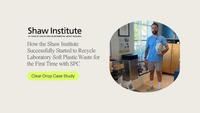
The Shaw Institute in Blue Hill, Maine, is a respected nonprofit research organization studying the impact of contaminants, including PFAS chemicals and microplastics — on human and environmental health. Their work is regularly published in leading scientific journals and covered by international media. The institute also operates an Environmental Education Center (EEC) featuring aquariums, marine mammal skeletons, and hands-on ocean exploration exhibits.
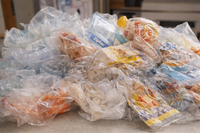
Like most laboratories, the Shaw Institute generates significant quantities of clean polyethylene (PE) and polypropylene (PP) soft plastic waste from daily research operations — including packaging from lab tools, sampling supplies, and delivery materials. According to the U.S. EPA, most municipal programs do not accept soft plastics, meaning nearly all of this material historically went to landfills.
To address this challenge, the Shaw Institute became one of the first research laboratories in the U.S. to pilot the Clear Drop Soft Plastic Compactor (SPC) — an on-site, lab-friendly solution designed specifically for soft plastic recycling. UNEP research highlights how important innovations like this are for managing flexible plastics responsibly.

Why the Shaw Institute Chose the Clear Drop SPC
Before implementing the SPC, staff had no practical way to recycle common laboratory soft plastics, including:
- polyethylene baggies and protective films
- bubble wrap and cushioning packaging
- sterile wrap and supply pouches
- other clean PE and PP packaging from lab operations
“We were looking for proven technology that could help us deal with the soft plastic problem in our lab and beyond,” explains Dr. Charlie Rolsky, Executive Director and Lead Research Scientist. “We're excited to pilot Clear Drop’s SPC device as part of our 2025 internal sustainability efforts. It offers a much-needed solution for improving our ability to recycle the soft plastic waste generated by our lab work.”

The Clear Drop SPC was selected because it:
- compresses clean soft plastics into dense, stackable blocks ready for certified recyclers
- requires minimal space and no heat or chemicals
- works precisely with PE and PP waste produced in labs
- supports the institute’s mission to reduce plastic pollution and “practice what they preach”
A detailed technical explanation of the device’s operation is available here.
Implementation and First-Month Results
The SPC was installed directly inside the laboratory — the primary source of soft plastic waste. Staff received training on cleaning, sorting, and feeding materials into the compactor. The installation required no facility modifications and integrated smoothly into daily workflows.
In the first month alone:
- 6 dense blocks of clean soft plastic waste were compacted and prepared for recycling
- 5 staff members plus several volunteers became regular SPC users
- The device operated safely and consistently in an active research environment
The SPC quickly became an effective tool for reducing landfill-bound laboratory plastics and improving internal sustainability practices.
Expansion Beyond the Lab
Although the initial goal was laboratory waste reduction, the pilot expanded naturally as staff recognized the device’s capabilities:
- Soft plastics from the Environmental Education Center (EEC) are now collected and processed
- Employees began bringing clean PE/PP soft plastics from home
- Once per week, the SPC is moved to a public EEC exhibit, where visitors can observe the compression process and learn about soft plastic circularity
This turned the SPC into both a practical waste-management device and a hands-on educational resource, supporting the institute’s public outreach mission.
Early Community Interest (Next-Phase Potential)
Building on the success of the internal pilot, the Shaw Institute is now exploring the idea of serving as a temporary community drop-off point where local residents can bring clean soft plastics for guaranteed recycling. While still in planning, this potential expansion aligns naturally with visitor engagement and mirrors other pilot models implemented by Clear Drop.
Key Benefits Realized by the Shaw Institute
- First-ever ability to recycle laboratory soft plastic waste on-site
- Significant progress toward near-zero-waste lab and facility operations
- Strong alignment between the institute’s research mission and daily sustainability practices
- A new educational tool demonstrating real-world soft plastic recycling
- Proven, low-maintenance technology suitable for research organizations of any size
The Shaw Institute pilot demonstrates that even small scientific institutions can successfully implement soft plastic recycling programs with the right equipment. For laboratories seeking a reliable, lab-safe, ready-to-deploy solution, the Clear Drop SPC offers measurable results and immediate environmental impact.
Explore the SPC here.