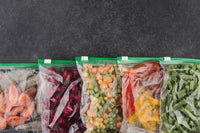
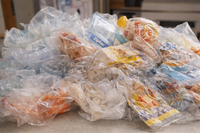
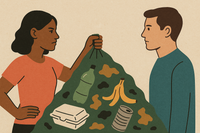
Fun fact: Soft plastics aren’t “unrecyclable.” They’ve just been collected the wrong way for over 30 years.
In the U.S., millions of tons of plastic film and bags are generated annually. However, only a small fraction is actually recycled because curbside systems are not designed to process flexible plastics. EPA data shows plastic recycling rates remain under 10%, with plastic film even lower.
The thing is, most soft plastics are perfectly reusable. They have the potential to live another 50+ years as something useful — that is, if they arrive at recyclers properly clean and compact.
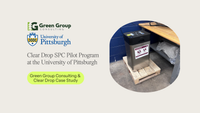
That’s exactly what the Clear Drop Soft Plastic Compactor (SPC) has been designed to do.
What Actually Happens After You Compact Your Soft Plastics With the SPC
Mechanical recycling is most efficient when the materials are single-stream and uncontaminated. This all starts with your SPC. Here’s how your soft plastics go from your home to living a new life:
- Add clean, dry LDPE/LLDPE (Low-Density Polyethylene/Linear Low-Density Polyethylene) plastic films to your SPC. These typically include general packaging film, bags, and liners.
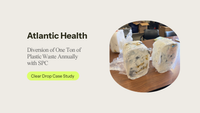
- The plastic is compressed into a dense, low-contamination block.
- Blocks are sent to certified U.S. recycling partners (film processors).
- They’re then shredded, melted, and pelletized into post-consumer rLDPE.
- Pellets become real everyday products, such as outdoor furniture, plastic lumber, and reusable bags.

High-purity LDPE film is one of the most sought-after recycled polymers — as long as the input quality is clean. Simply put: cleaner input leads to higher-grade output and more end-market applications.
That’s the SPC advantage.
7 Real Products Made From Recycled Soft Plastics in the U.S. Right Now

Here are a few valuable ways your soft plastics are being reused:
|
Product |
Real Brand Examples |
Bags/Film Per Item |
Lifespan |
|
Composite decking & railing |
Trex (world’s largest manufacturer of wood-alternative decking products) |
~2,800 bags per 16-ft. board |
25-50 years |
|
Outdoor furniture & benches |
~3,500 bags per 6-ft. bench |
50+ years |
|
|
Plastic lumber (boards, posts) |
~4,200 bags per 2×6×8 board |
50+ years |
|
|
Shipping pallets |
Greystone Logistics, ORBIS |
~2,000–2,500 bags per pallet |
10+ years |
|
Reusable bags & mailers |
EcoEnclose, Bag-2-Bag programs |
80–100 bags per reusable |
5-10 years |
|
Playground safety surfacing |
Surface America, SofSolutions |
~800,000 chip wrappers per 1,000 sq ft. |
15-25 years |
|
Underground conduit & piping |
ADS (Advanced Drainage Systems) |
Made from recycled film |
100+- year design life |
These are not prototypes! You can buy these products at major stores, including Home Depot, Lowe’s, and Menards, and see them being used in parks, schools, and homes across the U.S.
Recycled soft plastics are already everywhere — you’ve probably just never noticed them.
Why Recycling Soft Plastics Actually Matters (The Numbers That Don’t Lie)
-
Recycled plastic has lower carbon intensity than virgin resin (https://plasticsrecycling.org/resources/lca).
-
Recycling one ton of plastic film avoids substantial CO₂ emissions and resource extraction (obtaining raw materials) (https://www.epa.gov/warm).
-
Plastic reuse programs and businesses create more jobs than landfill disposal (https://www.tellus.org/).
-
LDPE recycling significantly reduces energy demand vs. virgin production (https://plasticsrecycling.org).
The future isn’t necessarily about “less plastic.” It’s about properly circulating the plastic we already have.
Drop Off vs. Clear Drop SPC — Why the SPC Wins

Why is the plastic recycling drop-off system so ineffective vs. the SPC? Let’s dig deeper.
|
Problem |
Drop-Off System |
Clear Drop SPC |
|
Contamination risk |
High (open, mixed waste) |
Low (compacted at source) |
|
Sorting required |
Yes (costly, error-prone) |
No (single-material stream) |
|
Transport cost |
High (bulky film) |
Lower (compressed blocks) |
|
Recycler acceptance |
Uncertain |
High (feedstock ready) |
|
Household participation |
Unstable |
Structured (consistent, habit-forming) |
The main difference? The drop-off system tries to recycle after failure happens. SPC prevents failure from the start.
Turn Your Trash Into Long-Lasting Products
With the SPC, every soft-plastic brick you produce becomes feedstock for real goods. Your plastic may just become:
- A park bench your kids will sit in
- A pallet that will move goods for over the next decade
- A decking board someone will stand on in 2075
Soft plastics aren’t the main problem. Collection is. Get your Clear Drop Soft Plastic Compactor (SPC) to be part of a recycling program that actually works.
Stop throwing away raw materials! Start building the future — one compacted brick at a time. ♻️