ZeroTrash® Revolution Blog Blog
Explore articles on recycling, waste management and sustainable habits by category

How Much Food Americans Waste and What You Can Do
Key Takeaways Americans waste 30%-40% of their total food supply each year (USDA, 2024). In 2019, the U.S. generated 66 million tons of wasted food, with more than half ending...
How Much Food Americans Waste and What You Can Do
Key Takeaways Americans waste 30%-40% of their total food supply each year (USDA, 2024). In 2019, the U.S. generated 66 million tons of wasted food, with more than half ending up in landfills (EPA, 2023). The average household loses ≈ $1,500 per year on food that is never eaten (NRDC, 2022). Food waste produces methane, a greenhouse gas that is 28x more potent than CO₂ (EPA, 2024). ClearDrop's Soft Plastic Compactor (SPC) and Organics Collector (OC) help reduce food waste and food-related soft plastics — one household at a time. Millions of tons of perfectly edible food are thrown away in the United States every year. Add to that all the water, land, fertilizer, energy, and packaging required to produce it. When wasted food ends up in landfills, it decomposes and releases methane, a potent greenhouse gas. The good news is that small, consistent changes at home can make a meaningful impact. Every household can reduce its environmental footprint with helpful tools, such as Clear Drop's Soft Plastic Compactor (SPC) for responsible soft plastic recycling, and the Organics Collector (OC) for clean food-scrap collection. 30%–40% of the total U.S. food supply is wasted each year. 66M tons of wasted food were generated in the U.S. in 2019. $1,500 is the average annual value of food wasted by one household. 28x more potent than CO₂ is methane released from food waste in landfills. The scale of food waste in America According to the U.S. Department of Agriculture (USDA), Americans waste up to 40% of their total food supply annually (USDA, 2024). U.S. households and retailers generated 66 million tons of food waste. 35 million tons of food waste were landfilled. Food became the largest single category of landfill material (EPA, 2023). What Americans waste most Tempted by bulk deals and discounted offers, Americans often overbuy at the grocery store, which leads to rotting produce and expired foods, including: Fruits and vegetables Dairy Baked goods Leftovers Prepared meals Remember that nearly all of these products come packaged in soft plastics, such as produce bags, bread bags, cereal liners, frozen-food bags, snack wrappers, and cling film. To save on waste, these materials can be compacted and recycled using the Clear Drop SPC. Environmental impact When food ends up in landfills, it decomposes and generates methane, a gas that is 28x more potent than CO₂ (EPA, 2024). Wasted food also wastes: 21% of all U.S. freshwater used in agriculture (WWF, 2023) 18% of U.S. cropland (Feeding America, 2023) Billions of units of packaging materials Significant transport and refrigeration energy Why this matters Food waste is not just about uneaten groceries. It also means wasted water, wasted land, wasted energy, and extra packaging that often ends up discarded with the food itself. There are two easy ways you can lower your food waste footprint: Clear Drop's OC allows you to cleanly collect food scraps so they don't end up in landfills. Clear Drop's SPC allows you to effectively recycle soft-plastic packaging to be repurposed instead of tossed out. Common reasons food gets wasted at home A lack of planning and preparation often leads to extra food and packaging waste. Cause Practical solution Overbuying and poor planning Create weekly meal plans and shop with a list. Expiration date confusion Understand “best by,” “use by,” and “sell by” labels (EPA Food Labeling Education). Improper storage Use airtight containers and humidity-controlled fridge drawers to keep food fresher longer. Forgotten leftovers Store leftovers in clear containers and rotate regularly. Packaging accumulation Rinse, dry, and compact food-related soft plastics using the SPC. Why reducing food waste matters Reducing food waste has wide-reaching benefits. Lowers emissions Less food in landfills means less methane released and a measurable climate benefit. Decreases packaging waste When you toss out food, you're also tossing out its packaging, such as: Produce bags Bread bags Shrink wrap Snack wrappers Frozen-food bags Cling film When you have an SPC, you can reduce this extra waste by easily compacting and recycling it. Supports sustainable living Clear Drop's mission is to help households reduce waste in all forms, starting with food scraps and soft plastics. Read more about our mission and products in our educational guides. Simple ways to reduce food waste Build meal plans and shopping listsPrevent overbuying before it starts. Store food properlyUse the right containers and fridge zones to extend freshness. Learn date-label meaningsDo not throw food away too early because of label confusion. Freeze leftoversSave food before it spoils. Reuse vegetable scrapsOr collect them for further composting via the Organics Collector. Keep products visibleUse clear labeling in your fridge and cabinets. Recycle soft-plastic food packagingUse the SPC for bread bags, snack wrappers, produce bags, and more. How Clear Drop supports sustainable living Clear Drop provides practical tools for reducing household waste, including: Soft Plastic Compactor (SPC) With the SPC, bread bags, produce bags, snack wrappers, cling film, cereal liners, and frozen-food bags can be properly compacted for recycling. Organics Collector (OC) With the OC, collect your food scraps without the fuss, mess, or smells. Clear Drop Blog With the Clear Drop Blog, learn more about reducing food and plastic waste and building a cleaner, more sustainable lifestyle. Be a leader in better waste management Reduce food waste, recycle smarter, and build a sustainable home with Clear Drop's: Soft Plastic Compactor (SPC) to reduce soft-plastic waste Organics Collector (OC) to compost cleanly and effectively Educational Blog to learn more about how to live a ZeroTrash lifestyle Explore the full Clear Drop system From food-scrap collection to soft-plastic recycling, Clear Drop helps households reduce waste with practical tools and education. Visit Clear Drop

How the Shaw Institute Successfully Started to ...
The Shaw Institute in Blue Hill, Maine, is a respected nonprofit research organization studying the impact of contaminants, including PFAS chemicals and microplastics — on human and environmental health. Their...
How the Shaw Institute Successfully Started to Recycle Laboratory Soft Plastic Waste for the First Time with SPC
The Shaw Institute in Blue Hill, Maine, is a respected nonprofit research organization studying the impact of contaminants, including PFAS chemicals and microplastics — on human and environmental health. Their work is regularly published in leading scientific journals and covered by international media. The institute also operates an Environmental Education Center (EEC) featuring aquariums, marine mammal skeletons, and hands-on ocean exploration exhibits. Like most laboratories, the Shaw Institute generates significant quantities of clean polyethylene (PE) and polypropylene (PP) soft plastic waste from daily research operations — including packaging from lab tools, sampling supplies, and delivery materials. According to the U.S. EPA, most municipal programs do not accept soft plastics, meaning nearly all of this material historically went to landfills. To address this challenge, the Shaw Institute became one of the first research laboratories in the U.S. to pilot the Clear Drop Soft Plastic Compactor (SPC) — an on-site, lab-friendly solution designed specifically for soft plastic recycling. UNEP research highlights how important innovations like this are for managing flexible plastics responsibly. Why the Shaw Institute Chose the Clear Drop SPC Before implementing the SPC, staff had no practical way to recycle common laboratory soft plastics, including: polyethylene baggies and protective films bubble wrap and cushioning packaging sterile wrap and supply pouches other clean PE and PP packaging from lab operations “We were looking for proven technology that could help us deal with the soft plastic problem in our lab and beyond,” explains Dr. Charlie Rolsky, Executive Director and Lead Research Scientist. “We're excited to pilot Clear Drop’s SPC device as part of our 2025 internal sustainability efforts. It offers a much-needed solution for improving our ability to recycle the soft plastic waste generated by our lab work.” The Clear Drop SPC was selected because it: compresses clean soft plastics into dense, stackable blocks ready for certified recyclers requires minimal space and no heat or chemicals works precisely with PE and PP waste produced in labs supports the institute’s mission to reduce plastic pollution and “practice what they preach” A detailed technical explanation of the device’s operation is available here. Implementation and First-Month Results The SPC was installed directly inside the laboratory — the primary source of soft plastic waste. Staff received training on cleaning, sorting, and feeding materials into the compactor. The installation required no facility modifications and integrated smoothly into daily workflows. In the first month alone: 6 dense blocks of clean soft plastic waste were compacted and prepared for recycling 5 staff members plus several volunteers became regular SPC users The device operated safely and consistently in an active research environment The SPC quickly became an effective tool for reducing landfill-bound laboratory plastics and improving internal sustainability practices. Expansion Beyond the Lab Although the initial goal was laboratory waste reduction, the pilot expanded naturally as staff recognized the device’s capabilities: Soft plastics from the Environmental Education Center (EEC) are now collected and processed Employees began bringing clean PE/PP soft plastics from home Once per week, the SPC is moved to a public EEC exhibit, where visitors can observe the compression process and learn about soft plastic circularity This turned the SPC into both a practical waste-management device and a hands-on educational resource, supporting the institute’s public outreach mission. Early Community Interest (Next-Phase Potential) Building on the success of the internal pilot, the Shaw Institute is now exploring the idea of serving as a temporary community drop-off point where local residents can bring clean soft plastics for guaranteed recycling. While still in planning, this potential expansion aligns naturally with visitor engagement and mirrors other pilot models implemented by Clear Drop. Key Benefits Realized by the Shaw Institute First-ever ability to recycle laboratory soft plastic waste on-site Significant progress toward near-zero-waste lab and facility operations Strong alignment between the institute’s research mission and daily sustainability practices A new educational tool demonstrating real-world soft plastic recycling Proven, low-maintenance technology suitable for research organizations of any size The Shaw Institute pilot demonstrates that even small scientific institutions can successfully implement soft plastic recycling programs with the right equipment. For laboratories seeking a reliable, lab-safe, ready-to-deploy solution, the Clear Drop SPC offers measurable results and immediate environmental impact. Explore the SPC here.

10 Soft Plastics You Didn’t Know You Could Recy...
Key Takeaways Only 1% of U.S. households have access to curbside film recycling. Home devices like the Clear Drop Soft Plastic Compactor (SPC) fill that gap. Soft plastics make up...
10 Soft Plastics You Didn’t Know You Could Recycle at Home
Key Takeaways Only 1% of U.S. households have access to curbside film recycling. Home devices like the Clear Drop Soft Plastic Compactor (SPC) fill that gap. Soft plastics make up ≈ 21% of the U.S. packaging market, yet only about 13% of all plastic packaging gets recycled nationally. Recycling soft films can reduce GHG emissions by 8%–23% compared to virgin plastic. Every ton of recycled plastics saves ≈ 5,800 kWh of energy and 1.7 metric tons of CO₂ emissions. No matter how diligent you are with recycling, most plastics labeled "recyclable" still end up in landfills. Curbside systems in the U.S. aren't designed for soft films and flexible packaging — meaning these materials often get rejected at the facility. Only 1% of U.S. households can currently recycle film plastics through local collection (The Recycling Partnership, 2021). The Clear Drop Soft Plastic Compactor (SPC) fills that gap — letting you collect and compact soft plastics at home so they can be properly recycled through certified partners. Why Soft Plastic Recycling Matters 21% of U.S. packaging sales are soft plastics — a $41.5 billion market with a recycling rate near zero 13.3% national plastic packaging recycling rate — soft plastics represent only a fraction of that 3.1B lbs of film plastic must be recovered annually just to reach a 30% recycling rate 8–23% reduction in GHG emissions when recycling flexible plastics vs. producing virgin material Clearly, there's plenty of room for improvement — and it can start one home at a time with the Clear Drop SPC. 10 Surprising Soft Plastics You Can Recycle All of the following items are often rejected by curbside systems but can be accepted by the Clear Drop SPC, once cleaned and dried: 1. Ziplock bags Rinse, dry, and add to the SPC. 2. Bread bags (typically LDPE #4) Empty, shake out crumbs, and dry completely before compacting. 3. Cereal box liners Separate the inner film liner, dry it, and add to your SPC. 4. Frozen food bags After use, defrost, rinse off residue, dry, and add to the SPC. 5. Bubble mailers Plastic-only mailers (without paper layers) can be deflated and compacted. 6. Snack wrappers Single-layer poly wrappers (e.g., granola bars) are fine — just avoid any with metallic film. 7. Produce wrap Most cling film from fruit and veggie trays is LDPE — rinse, dry, and compact. 8. Pet food bags Clean out oily residue from PP (polypropylene) bags, dry, and compact. 9. Dry cleaning bags Remove tags or tape, dry, and feed into the SPC. 10. Packaging air pillows Deflate, flatten, and compact these LDPE shipping cushions. When compacted, all of the above films become part of your SPC block — a dense, clean unit ready for recycling. How to Prepare Soft Plastics for SPC Recycling Clean: Rinse off all food or oil. Dry: Air-dry thoroughly. Compact: Insert the plastic into your SPC. Ship or Drop Off: Send your full soft-plastic block to a Clear Drop partner. Do's and don'ts Do: Rinse and dry plastics, remove labels, keep items light.Don't: Include wet, dirty, or foil-lined film. What Happens After Collection: The SPC Recycling Process From your home to a new product SPC blocks go to certified U.S. recycling partners like Frankfort Plastics in Indiana — where plastics are sorted, shredded, cleaned, and pelletized into new resin used for outdoor furniture, decking, and composite pallets. Transport & Inspection: SPC blocks go to certified U.S. partners, such as Frankfort Plastics in Indiana. Sorting & Shredding: Plastics are sorted and granulated. Cleaning & Pelletizing: Flakes are washed and melted into new resin. Reuse: Resin becomes new durable construction products — outdoor furniture, decking, composite pallets. The energy impact According to the EPA, recycling one ton of plastics saves ≈ 5,800 kWh of energy and prevents 1.7 metric tons of CO₂ emissions (EPA 2024). By using the SPC, you help turn hard-to-recycle films into feedstock for new products — closing the loop. The Clear Drop SPC in Numbers Metric U.S. Statistic Source Soft-plastic share of packaging ≈ 21% ($41.5 billion market) Packaging Digest 2023 National plastic-packaging recycling rate 13.3% US Plastics Pact 2024 Households with film recycling access ≈ 1% The Recycling Partnership 2021 Goal for 30% film recycling 3.1 billion pounds needed annually The Recycling Partnership 2021 GHG savings from film recycling 8%–23% Plastic Film Recycling Org Plastic recycled in North America (2025) 4.2 million tons (≈ 13% of PE/PET/PP) Sustainable Packaging Coalition 2025 Be a leader in better recycling Recycle more than you thought possible with the Clear Drop SPC — and cleanly collect food scraps with the Organics Collector. Explore Clear Drop Solutions →

How Clear Drop’s Soft Plastic Compactor (SPC) R...
At Clear Drop, we're redefining what responsible soft plastic recycling looks like. Our Soft Plastic Compactor (SPC) ensures that your household soft plastics don't just get collected, they get truly...
How Clear Drop’s Soft Plastic Compactor (SPC) Recycling System Works | Clear Drop
At Clear Drop, we're redefining what responsible soft plastic recycling looks like. Our Soft Plastic Compactor (SPC) ensures that your household soft plastics don't just get collected, they get truly recycled into new, long-lasting materials through certified U.S. partners. Key Takeaways The Clear Drop SPC compacts household soft plastics into dense blocks ready for certified recycling. Compacted blocks are shipped via USPS prepaid labels to Frankfort Plastics (Indiana), a verified U.S. recycling partner. Recycled material becomes durable goods: construction products, outdoor furniture, and composite panels. The system is fully traceable, so you know exactly where your plastic goes and what it becomes. Use the ClearDrop Recycling Scanner to identify which soft plastics can go in the SPC. Where the waste goes after the SPC Every SPC block you send represents real impact. Once compacted, your soft plastics are shipped to verified recycling partners like Frankfort Plastics (Indiana), specialists in processing post-consumer soft plastics into high-quality, reusable raw materials. Transparency is at the core of Clear Drop's mission. You deserve to know where your waste goes and what it becomes after leaving your home. ~9% of all plastic ever produced has been recycled. Most ends up in landfills or the environment. 100% of SPC blocks are shipped to verified U.S. recycling partners, with no guessing where your plastic goes. 3 prepaid mailers are included each quarter. Drop them at USPS or schedule a pickup from home. 0 soft plastics are accepted by most curbside programs. The SPC helps fill that gap. How Clear Drop recycling system works Our process is simple, traceable, and circular, designed for convenience and accountability. Receive your mailers.Each quarter, you'll receive a set of three prepaid SPC mailers with shipping labels. Send your compacted block.Once your block is full, place it in a mailer, attach the prepaid label, and seal it. Drop it off or schedule pickup.Leave your package for USPS pickup or drop it at any nearby post office. We take it from there.Your block is delivered to a certified facility, where it's sorted, shredded, and transformed into recycled soft plastic for new products. Watch the full ClearDrop SPC recycling process on YouTube to see how your soft plastics are compacted, shipped, and transformed into new materials. What the waste becomes after it's recycled Your compacted plastics begin a new, sustainable life. After processing, the recycled SPC material is used in: End Product Category Composite decking and outdoor furniture Construction & outdoor Composite panels Industrial components Durable construction materials Building & infrastructure Each block you send helps reduce landfill waste, prevent microplastic pollution, and support circular manufacturing. How Clear Drop compares to other soft plastic recycling options Clear Drop SPC Store Drop-Off Curbside Recycling Accepts soft plastics ✅ Yes ✅ Limited ❌ No Verified end destination ✅ Yes ❌ No ❌ No Works from home ✅ Yes ❌ No ✅ Yes Traceable recycling chain ✅ Yes ❌ No ❌ No Prepaid shipping included ✅ Yes ❌ No N/A Material becomes new products ✅ Verified ⚠️ Unverified ❌ No Our recycling partners We carefully select and audit our U.S. partners to ensure full accountability and compliance with national recycling standards. Current verified partner: Frankfort Plastics — Indiana, USA (post-consumer soft plastic recycling) We're expanding our network with additional regional facilities planned for 2026, ensuring shorter logistics chains and a lower carbon footprint. Why Clear Drop matters for sustainable waste management Most soft plastics never get recycled. Instead, they break down into microplastics and contaminate soil, water, and air. Did you know? Soft plastics wrap around sorting machinery at recycling facilities, causing shutdowns and contaminating other materials. That is why curbside programs usually reject them. Compacting soft plastics reduces their volume by up to 50x, making transport dramatically more efficient and cost-effective for recyclers. Recycled soft plastic becomes long-lasting materials like composite decking and construction panels, not single-use products. Why this matters When soft plastics aren't properly recycled, they fragment into microplastics that contaminate soil, waterways, and the food chain. The SPC closes this loop by ensuring your plastics reach a verified facility, not a landfill. With Clear Drop's SPC system, you're helping: Prevent plastic fragmentation and microplastic pollution Cut greenhouse gas emissions from landfill decomposition Promote transparent, traceable recycling across the U.S. Together, we're building a clear, closed-loop recycling model, one SPC block at a time. 1 year of using SPC Ready to start recycling soft plastics from home? The SPC handles collection, compaction, and shipping to verified U.S. recyclers, all in one system. Pre-order the SPC
How Geekdom sparked early wins in soft plastic ...
Geekdom is a cornerstone of San Antonio’s startup and innovation ecosystem. Spread across four floors in a prominent downtown building, it houses approximately 40 startups and plays host to a...
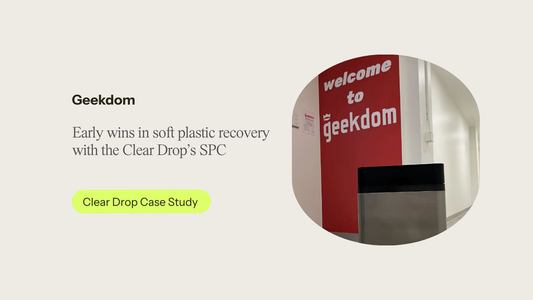
How Geekdom sparked early wins in soft plastic recovery with the Clear Drop's SPC
Geekdom is a cornerstone of San Antonio’s startup and innovation ecosystem. Spread across four floors in a prominent downtown building, it houses approximately 40 startups and plays host to a steady calendar of events: game jams, hackathons, seminars, and tech conferences. It’s the epicenter of the city’s entrepreneurial and venture community. Like many innovation hubs, Geekdom grapples with high volumes of everyday office & food packaging waste. Prior to the pilot, there was no structured process to recover or reduce this plastic waste stream. Pilot goals: Understand employee interest and engagement around soft plastic recycling Measure volume and speed of soft plastic accumulation Evaluate SPC’s role in supporting Geekdom’s broader sustainability and community values Approach Geekdom saw potential in the SPC’s ability to foster a shared community action around sustainability. The device was installed in a common area used by many different startup teams throughout the day, encouraging collaborative stewardship. The pilot was supported by custom signage near the kitchen/break room, table tents on community tables, and direct email outreach to all staff and tenants coordinated with Geekdom’s operations team. Geekdom staff even made their own signage :) Metrics: 1 SPC deployed 2 full soft plastic blocks created in under 2 months Employee participation was tracked qualitatively through conversations and visual observation Improvements are now in the works after receiving awesome critical feedback from staff on signage and the device’s instant recognizability as a recycling device. Materials inserted: Mailers and plastic wrappers from startup equipment Grocery bags, sandwich wrappers, and snack packaging from shared lunches Miscellaneous soft film plastics found around events “As someone who loves to recycle I want this in my home! It’s so easy to use, and gives me a way to recycle what is normally trash” - Julez Perez. Summary Geekdom views the SPC not just as a waste solution but as a community-building tool. In just two weeks, tenants filled a full block with soft plastics, demonstrating both engagement and the real waste footprint of a single floor. The operations team is now in deeper conversations with ClearDrop to potentially expand the pilot to multiple floors. Their slow-roll strategy allows for organic feedback and culture-based insights, helping refine messaging and product design while reinforcing Geekdom’s mission to lead in innovation and sustainability.