What Is an Organics Collector? (And Why It's Not a Composter)
A quick search for a "composter appliance" or "smart compost bin" may just leave you with more questions. Your search will likely pull up dozens of products, all promising the same thing but all doing something slightly different.
But here's what most product pages don't tell you upfront: An organics collector and a composter are fundamentally different tools. If you opt for the latter, you may end up with a device that doesn't fit your lifestyle, a kitchen that still smells, and a habit that doesn't stick. To find the best organic waste solution for you, keep reading to learn more about the key differences between a composter and an organics collector.
The Problem With Calling Everything a "Composter"
People that search for an indoor food waste solution, typically end up comparing grinders, dehydrators, fermentation units, and collection bins as if they were all interchangeable. They're not. While "composter appliance" has become a catch-all term for these products, each type of device solves a different problem at a different stage of the waste cycle.
Even people who've been diligently managing their organic waste for years run into this confusion. One of our customers — Kris, an eco-conscious tech professional from Oregon — had no idea this product category existed before stumbling across it. He'd been using a sealed mixing bowl for years and only started researching alternatives when he saw the phrase "composter appliance" for the first time.
Another customer, Lauren, had been composting in her backyard for over five years and tried multiple indoor collectors with filters. They all failed: fruit flies, persistent odors, and leaking bags were all too common. She didn't realize the core issue was the type of product she was choosing.

What a Composter Actually Does
A true electric composter is a processing machine. Its job is to transform food scraps into something smaller and drier, typically through heat, grinding, or fermentation. Depending on the type, it will:
- Reduce waste volume by 60%–90%
- Produce a dry, powder-like output
- Run in cycles that can last several hours
- Use anywhere from 0.5 to 1.5 kWh per cycle
Electric composters are also noisy during cycles, use significant energy, require regular maintenance, and often emit unpleasant odors. They can work well if you're someone with outdoor garden space who wants to close the loop completely at home. But for everyone else, they're often the wrong tool.
What the Organics Collector Does Instead
An organics collector solves a completely different problem — one that most of us can relate to.
The real bottleneck in food waste management isn't processing, but storage. Most people end up not separating their organic waste, not because they don't care, but because storing it is genuinely unpleasant. Food scraps smell, attract fruit flies, cause leaks, and require regular emptying.
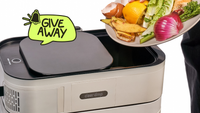
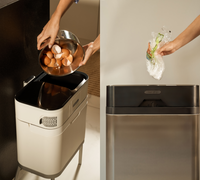
The Clear Drop Organics Collector (OC) addresses every one of these frustrations. Instead of trying to process waste, it focuses on storing it cleanly by using active airflow, a charcoal filter, and a sliding sealed lid to eliminate odor and pests. You can store organic waste in the OC for up to one week before disposing of it through your city's organic pick-up, a community composting program, or your own backyard pile.
With the OC, enjoy eco-conscious composting with:
- No odors, even without liners
- No fruit flies, even in the summer
- Less frequent emptying
- A counter-friendly bin that stays clean
"The fan and filter actually worked. No flies, no smell, no mess. That had never been true for any product I'd used before." — Lauren, OC customer, 5+ years composting
"It just makes composting easier — it's an upgrade from a simple trash bin." — Kris, OC customer, Oregon
► See how the Organics Collector works →
Organics Collector vs. Electric Composter vs. Regular Bin
Your decision really comes down to your set-up.
If you have a garden and want to produce usable material at home, an electric composter may be the right fit. However, if you buy an electric composter expecting a clean, low-effort kitchen solution, you'll only end up with extra noise, heat, and a maintenance schedule. On the other hand, if you buy a basic sealed bin to keep odors out you'll likely get fruit flies within a week.
If you want a clean, odor-free, low-maintenance way to separate organic waste, the Organics Collector is exactly what you're looking for — especially if you have limited counter space. With the OC, separating your food scraps becomes a habit as easy as tossing away any other type of trash.
| Feature | Organics Collector | Electric Composter | Regular Bin |
|---|---|---|---|
| Purpose | Store & manage waste cleanly | Process waste into dry material | Temporary disposal |
| Odor control | High (filters + airflow) | Medium | Low |
| Energy use | Minimal | High (0.5–1.5 kWh/cycle) | None |
| Output | Raw organic waste for collection | Dry pre-compost material | Mixed waste |
| Best for | Apartments, cities, households with collection access | Home gardeners, self-contained processing | Basic use |
| Maintenance | Low | Medium–high | Low |
| Pest control | Yes | Sometimes | No |
| Noise | Quiet fan | Cycles can be loud | None |
The Environmental Impact
When it comes to choosing a kitchen compost bin vs Organics Collector, the environmental impact can be significant. According to the U.S. EPA, food waste makes up around 24% of all material sent to a landfill, and is responsible for 58% of fugitive (unintentional) methane emissions from municipal solid waste landfills.
Methane is up to 80 times more potent than CO₂ over a 20-year period. This means keeping food waste out of landfills is one of the fastest ways to reduce household greenhouse gas emissions. This is possible to do — one household at a time.
of all landfill material is food waste, according to the U.S. EPA.
of fugitive methane emissions from landfills come from food waste.
more potent than CO₂ is methane over a 20-year period.
household at a time — that's how change starts.
Who the Organics Collector Is For
The OC was designed for people who want to dispose of their food waste in the most earth-friendly way — but with a solution that actually fits into their everyday life. The OC is best for:
- People in apartments or homes with limited counter space
- Households that rely on municipal organic waste pick-up
- Anyone who's tried and abandoned other solutions because of odor or pests
- Environmentally conscious users who want convenience
"I think for those who are conscious about the environment, this is actually something you can do to make a difference." — Kris, OC customer
The OC can help you make sure food waste never ends up in a landfill. OC customer Kris doesn't garden. He relies on his city's organic waste pick-up every two weeks. With the OC, he's easily made separating organics a frictionless (and odor-less!) habit.
If you're also looking for an easy solution to collect and manage soft plastic at home, check out Clear Drop's Soft Plastic Compactor, which pairs perfectly with the OC as part of a complete household waste system.
Ready to make composting effortless?
The Organics Collector is designed for real kitchens and real lives — no smell, no fruit flies, no daily frustration.
Discover the Organics Collector →